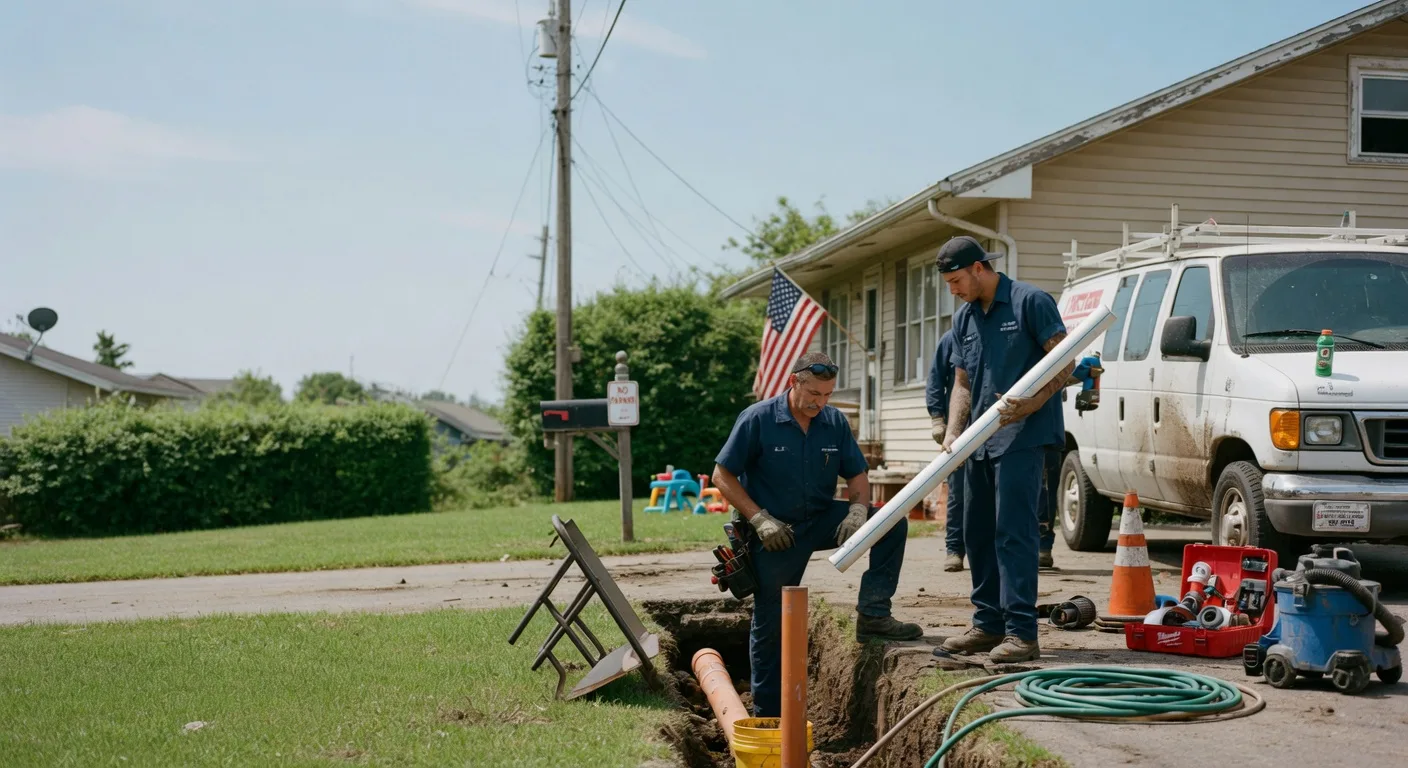
What does it mean if the cable machine stops at the same distance every time?
The cable stops dead at the same spot every time, and the plumber says it feels like a wall. That tells you the problem is fixed in one place. It is not a soft blockage that moves.
Common causes are tree roots that have grown in at a clay pipe joint, a section that has dropped or cracked, or a bellied line where the pipe sags and holds water. It can also be a bad coupling where one pipe no longer lines up with the next. A cable can punch through roots or grease, but it cannot get past a pipe that has shifted or broken.
Note the distance the cable went in. That number tells the next plumber where to look, and whether the fault is inside the house or out in the yard.
Safe homeowner check: if only one fixture is slow, go easy on water and note which drain it is. Stop running water and call now if several drains back up, if water comes up in a tub or floor drain, or if there is a sewage smell indoors.
A camera inspection is the right next step, because it shows what the cable hit. Roots or heavy grease may clear with hydro jetting. A broken or bellied pipe is a repair, and the cost depends on access, how much has to be dug or opened, the materials, and any permit required. Expert Plumbers Co is a referral service. Call (380) 262-9173 and we will connect you with a plumber in Waterloo, OH for Drain Cleaning.
Mark the spot where the stoppage sits if the cleanout or access point makes that possible, and tell the plumber whether the line runs under a slab, a driveway or a lawn. That decides how the repair is approached and how much has to be opened up. In older homes, the stoppage is often a clay joint that has been invaded by roots or has slipped, and the fix may be a spot repair on one section instead of replacing the whole run. In newer homes a stop at the same distance is more often a poorly set joint or a fitting that was installed out of line. After the camera has found the fault, ask for the footage or a few stills. They show the pipe material, the condition on either side of the problem and whether other weak points are coming. Until the repair is done, expect the line to clog again, so keep water use low and avoid putting anything but waste and paper into it.
Why did my drains stop working in freezing weather?
Every drain in the house is slow or dead, something is gurgling, and it started on a hard-frost morning. Where Waterloo, OH gets a hard freeze, that usually points to ice in a pipe or ice at the top of the vent stack.
Frozen lines first. In colder states a sewer lateral can sit shallow enough for frost to reach it. Any sagging section holds a little water, and that water turns to ice. An un-insulated drain in a crawlspace or garage can freeze the same way.
Then the vent stack. Warm, damp air rises through the vent and meets freezing air at the roof opening. Frost builds ring by ring until the opening closes. With no air coming in, drains cannot flow. That is the gurgling you hear.
A frozen line and a root blockage look identical from inside the house. Both give slow drains and standing water. The weather, or a camera inspection, tells them apart.
Do not pour boiling water down a frozen line. Sudden heat can crack cast iron or split a trap, and then you have a leak too.
Safe homeowner check: see whether one fixture is slow or every drain is, look at the roof vent from the ground, and feel exposed pipe for a cold, stiff section.
Stop running water and call now if every drain is backing up, water is rising in a tub or floor drain, or you smell sewage. A single slow sink is usually a trap or branch job a cable machine can clear. A whole-house freeze-up or a suspect lateral may need a camera inspection, thawing equipment or hydro jetting, which is where emergency drain cleaning comes in.
Expert Plumbers Co is a referral service. We connect you with an independent local plumber in Waterloo, OH. Call (380) 262-9173.
Once the thaw is done, expect the problem to come back unless the cause is fixed. If a shallow section froze, ask the plumber to note its depth and whether the pipe has a belly that holds water, since that spot will freeze again. A cold crawlspace or garage drain can be wrapped with pipe insulation, and heat tape made for drain lines can help in short cold snaps, but it must be installed to the maker's instructions. For a frosted vent, keep snow clear around the roof opening, and tell the plumber if the vent is narrow, since a wider vent closes up less quickly. In older homes the vent opening is often smaller and the drains less well insulated, so the same cold snap hits harder. After a freeze, watch for leaks at joints and traps as the ice melts, because expanded pipe can split quietly and only show water once it warms. If you see damp spots later, tell the plumber what happened.
Can my downspouts or sump pump cause a sewage backup?
Every drain is gurgling and dirty water comes up the basement floor drain, but only when it rains. That is not one slow sink. Storm water is a prime suspect.
In older housing stock, gutters, a yard drain or a sump pump discharge were sometimes plumbed straight into the sanitary sewer. In a storm, all that extra water floods the house lateral and the municipal main. The pipe runs full, so sewage is pushed back up the lowest opening: a floor drain, a basement shower, a laundry standpipe.
Many jurisdictions now prohibit this. Disconnecting it is often a permit or code matter.
Safe homeowner check: walk the outside of the house. See where each downspout ends. Does it spill onto the ground, or vanish into a pipe in the soil? Does the sump pump discharge run out to daylight, away from the foundation, or into a pipe tied to the house drain? Look only. Do not dig.
Stop running water and call now if more than one fixture is backing up, if sewage is rising, or if it is reaching the floor. A single slow sink is a different job, and a cable machine usually handles it. A storm-driven backup is not a clog, so cabling will not cure it.
A plumber finds the connection with a camera inspection, which shows a tie-in on the pipe, or a dye test, where colored water poured into a downspout or sump shows up in the sewer. What the work involves depends on access, the materials, how much has to be opened up, and any permit requirement.
Expert Plumbers Co is a referral service. We refer homeowners in Waterloo, OH to an independent local plumber for Drain Cleaning and Emergency Drain Cleaning. Call (380) 262-9173.
Once the connection is found, the usual fix redirects the storm water instead of changing the sewer. Downspouts can be extended to discharge onto the ground well away from the foundation, with the soil graded to carry water off. A sump discharge should run outdoors to daylight or to a drainage point that local code accepts.
A common mistake is capping the old pipe at the wall and leaving the buried tie-in open to the sewer. An open stub can still admit soil, roots and water. Ask the plumber to confirm the old connection is sealed at the sewer end, not just hidden from view.
Sump pumps run hardest during the very storms that load the sewer, so a pump that cycles constantly is worth mentioning on the call. After the change, watch the next heavy rain. The floor drain should stay quiet. If it still gurgles, the cause may be the street main or a damaged lateral, not the tie-in.
When I run one side of my double kitchen sink, water comes up in the other side. Why?
When water from one basin rises in the other, both bowls are sharing a drain that is partly blocked downstream of where they join. The two basins feed a single tailpiece and trap, and the water has nowhere to go but back up the second bowl. The clog is almost never in the basin you are looking at.
The usual cause is grease and food residue that has built up on the pipe wall past the trap, narrowing the pipe until it can pass only a trickle. Sometimes the blockage sits in the horizontal pipe inside the wall, or further along where the kitchen line meets the main drain.
Safe checks you can do: run only the cold tap for a minute and see whether the water in the second bowl rises slowly or fast. Look under the sink for a leak at the trap and the connection between the two bowls. Remove the trap if you are comfortable doing so, with a bucket under it, and clear out what is inside. Skip chemical drain cleaner, since it sits in a standing pipe and can damage fittings and hurt whoever opens the trap next.
If the trap is clear and the water still climbs into the other bowl, the blockage is deeper. A cable machine is often enough for a soft grease and food plug. If the line clogs again within weeks, grease has likely coated the pipe wall, and hydro jetting scours it clean in a way a cable cannot. A camera inspection is worth asking about when the same line keeps returning, because it can show a bellied section holding water or a damaged joint that cleaning alone will not fix.
Stop running water and call promptly if the backup is also showing in other drains, if you smell sewage, or if water is coming up from a floor drain or toilet. That points to the main line rather than the kitchen branch, and every extra gallon you send down ends up on your floor.
Cost depends on access to the pipe, whether a cleanout is available, how far the blockage sits from the opening, and whether any section has to be opened up or replaced.
Expert Plumbers Co can connect you with an independent local plumber in Waterloo, OH when you call (380) 262-9173.
Will baking soda and vinegar, or a kettle of boiling water, clear a slow drain?
You have a slow drain, so you tried baking soda and vinegar, or a kettle of boiling water. It still crawls, or the clog is back by morning. That is the usual result.
The fizz is mild. It can freshen a drain, but it does nothing to a solid clog of hair, soap scum, grease or paper. Boiling water melts grease for a moment, then the grease cools and sets again further down the pipe, where it is harder to reach. Boiling water can also soften PVC joints and crack porcelain. Hot tap water is safer than a kettle.
The real causes sit deeper: grease build-up on the pipe wall, scale in old cast iron, roots entering a clay joint on the main, or a bellied line that holds water and solids at its low point. A blocked vent stack can also make a drain sluggish and gurgling, which looks like a clog but is an air problem.
Count the affected drains. One slow fixture usually means a hair, soap or grease clog in that fixture or its branch. If the tub, sinks and toilets all run slow together, or you hear gurgling after a flush, the trouble is in the main line or vent, and no kitchen remedy will reach it.
Safe homeowner check: Remove the stopper or strainer and clear hair and residue by hand. Try a plunger with a good seal. Run hot tap water, not boiling. Check whether other fixtures are slow. Avoid stacking store-bought chemical cleaners, which can sit in a standing pipe.
Stop running water and call now if more than one fixture is backing up, if dark water is rising in a tub or floor drain, if you smell sewage, or if water comes up when you flush or drain the washer.
A cable machine is usually enough for a clog in a single branch. Hydro jetting is the better tool when grease or scale coats the pipe wall. A camera inspection is the right step when the drain clears and slows again within days, since that pattern points to a belly, roots or a damaged section.
Expert Plumbers Co is a referral service. We connect you with an independent local plumber in Waterloo, OH. Call (380) 262-9173.
Tell the plumber what you already tried. Ask what they found in the line, not only that it was cleared. The scope depends on access to the pipe, whether a fixture has to be removed, the pipe material, and whether the cause is a simple clog or damage that needs repair.